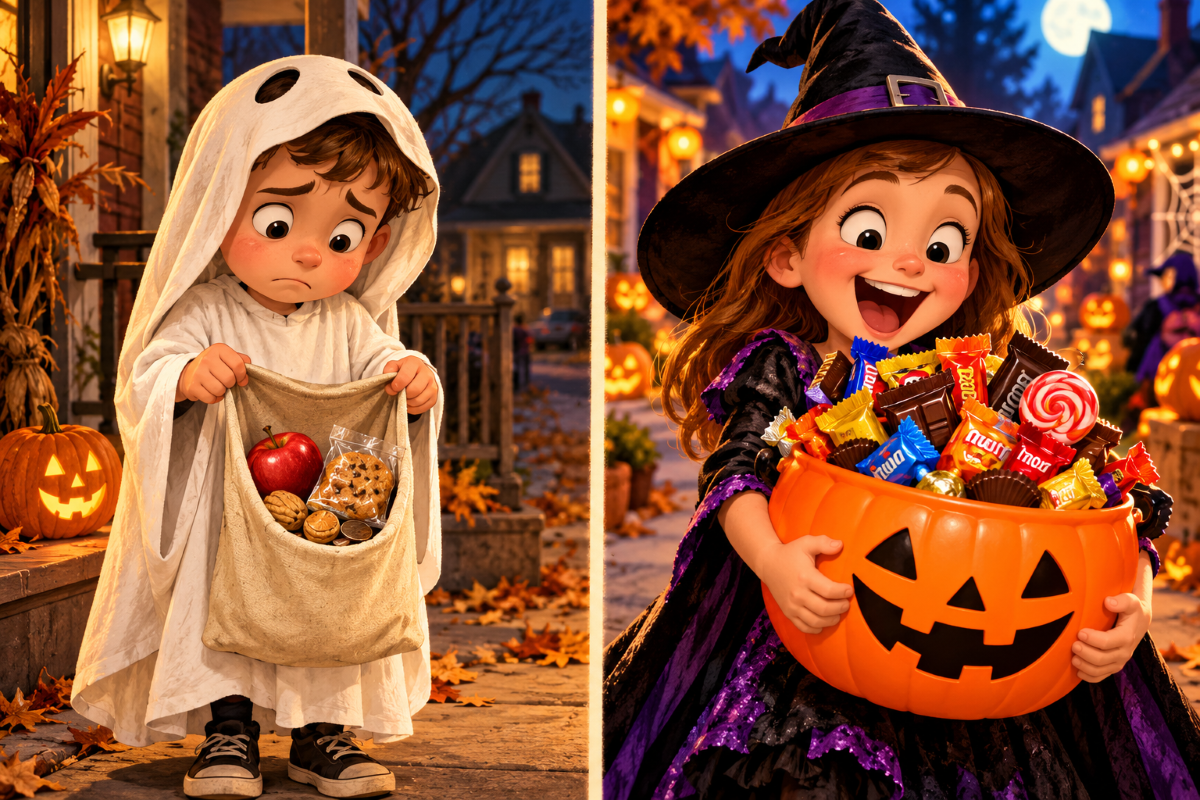
Imagine going trick-or-treating and coming home with apples, nuts, homemade cookies and a few pennies.
No Snickers. No Reese’s Peanut Butter Cups. Not even a lousy Tootsie Roll.
Kids today would lead a Halloween insurrection.
Candy wasn’t always the main attraction on October 31. The holiday existed long before anyone thought to distribute individually wrapped chocolate bars to children dressed as Power Rangers.
So, how did Halloween become an annual sugar extravaganza?
Halloween Before the Sugar Rush
Halloween’s roots go back centuries, with traditions involving costumes, bonfires, spirits and community celebrations.
In parts of Europe, people went door-to-door asking for food or performing songs in exchange for treats. These customs eventually helped inspire modern trick-or-treating.
When Halloween celebrations became popular in America, the emphasis was largely on parties, costumes, games and neighborhood gatherings.
Bobbing for apples was considered entertainment.
Try suggesting that to a group of 10-year-olds today.
When Tricks Were Actually Tricks
Before trick-or-treating became widespread, Halloween had a reputation for mischief.
Pranks ranged from harmless activities to vandalism, and communities looked for ways to make the holiday less destructive.
Organized parties and neighborhood trick-or-treating helped redirect that energy.
Children went door-to-door, and homeowners handed out whatever they had available, including fruit (lame), nuts (also lame), coins (not so lame), cookies (not lame) and homemade treats (it depends).
Candy was around, but it hadn’t yet claimed ownership of the holiday.
Enter the Candy Companies
By the 1950s, trick-or-treating was becoming an established American tradition, and candy manufacturers recognized a golden opportunity.
Small, individually wrapped candies were convenient, inexpensive and easy to distribute.
Advertising reinforced the connection between Halloween and candy.
By the 1970s, commercially packaged candy had become the preferred handout in many neighborhoods, helped by growing concerns about accepting homemade treats from strangers.
Along the way, miniature chocolate bars became the official currency of childhood happiness.
The Great Halloween Candy Hierarchy
Of course, not all candy is created equal.
Every trick-or-treater develops a ranking system.
Full-size chocolate bars occupy the penthouse. Reese’s, Snickers and Kit Kats enjoy prime real estate.
Then come the respectable supporting players.
Finally, there’s that mysterious assortment of candies nobody remembers purchasing, yet somehow they appear in Halloween bowls every year.
After trick-or-treating comes the sorting, trading and negotiating.
A miniature bag of candy corn for a Reese’s?
Nice try.
Halloween Has Become Big Candy Business
Today, Americans spend billions annually on Halloween candy. Grocery stores devote entire aisles to it, and seasonal varieties appear weeks before the holiday.
We buy bags for trick-or-treaters, bags for parties and bags supposedly for trick-or-treaters that somehow disappear before October 31.
Nobody knows how that happens.
Halloween survived for centuries without miniature candy bars.
Personally, I’m glad we moved beyond bobbing for apples.
🎃 SHAMELESS PLUG ALERT 🎃
We would never whet your candy appetite and leave you hanging. Check out our Haunted Halloween Gift Basket, packed in a gift box and howling with a mix of classic candy, including Reece’s peanut butter cups, Fun Dip, Pop Rocks, Mary Janes, Necco Wafers, Caramels, Hard candy, and more.
About BasketWorks
BasketWorks is a woman-owned gift basket company located in the north suburbs of Chicago (specifically Northbrook, IL) since 1997. We are proud to offer a variety of gifts and gift baskets appropriate for all occasions. Each of our packages is built to order, allowing for customization at no additional cost to our clients. Contact us today!
Please subscribe to our blog, and follow us on Facebook, Instagram, Threads, and LinkedIn.